
Canadian Tax Guide 2025-26
Smart Strategies to Keep More of Your Wealth
What Is Tax?
At its simplest, tax is a mandatory financial charge imposed by the government on individuals and businesses. It is the revenue source that funds public infrastructure and essential services we rely on daily, including:
- Universal healthcare
- Public education
- Roads, bridges, and transit
- Emergency services and national defense
While taxes are necessary for a functioning society, paying more than your fair share is not.
A Brief History: When Did Income Tax Start?
Many Canadians believe income tax has always existed, but it was actually introduced as a "temporary" measure.
The Origin (WWI)
The Income War Tax Act was first introduced in 1917 to help finance World War I. It was promised to be temporary, but as government spending grew, so did the need for revenue.
The Modern System (Post-WWII)
Following World War II, the Canadian government needed a more robust system to fund the growing social safety net. In 1948, the government passed the Income Tax Act. This massive piece of legislation replaced the old wartime act and laid the foundation for the modern, progressive tax system we use today.
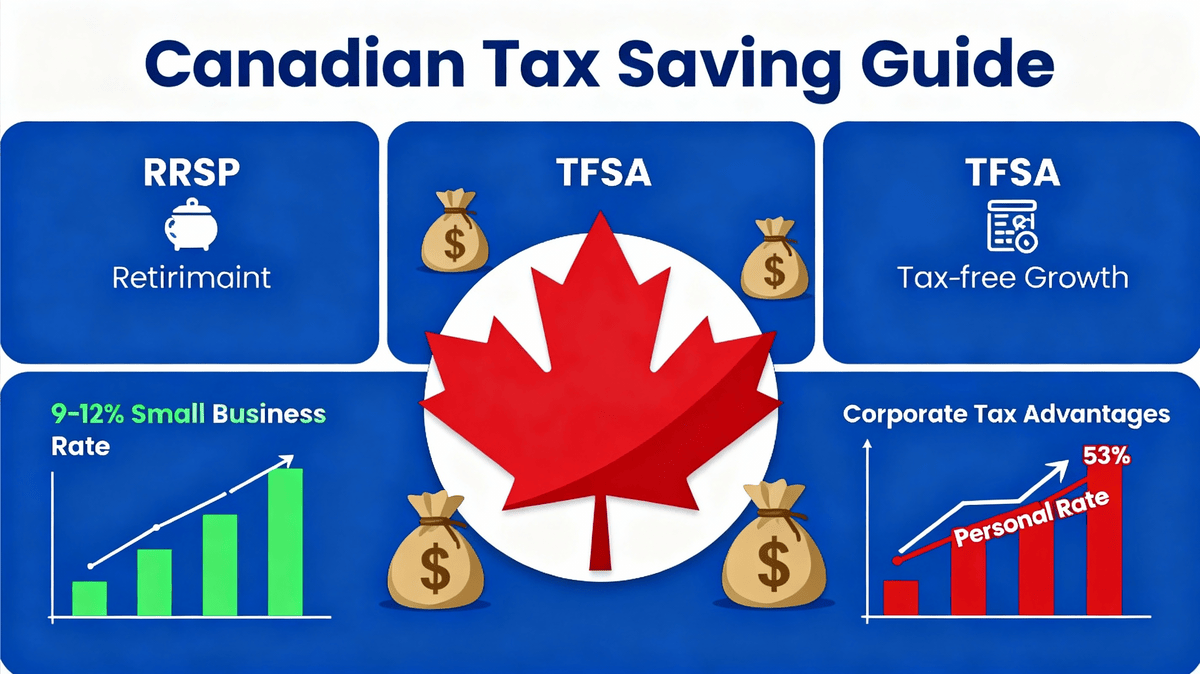
Why Canadian Tax Is Friendlier to Corporations
You may have heard that business owners pay less tax. In many cases, this is true due to the Small Business Deduction (SBD) and the concept of Tax Deferral.
While an individual might pay a marginal tax rate of 50% or more on high income, a Canadian-Controlled Private Corporation (CCPC) pays a much lower rate on its first $500,000 of active business income.
Key Corporate Advantages
- Lower Tax Rates: The combined federal and provincial corporate tax rate for small businesses is often between 9% and 12% (depending on the province). This is significantly lower than personal income tax rates.
- Tax Deferral: Corporations allow you to leave money inside the company. Since it is taxed at a lower corporate rate, you have more capital available to re-invest in the business or passive investments compared to if you had withdrawn it all as personal salary.
- Income Splitting: While rules have tightened, corporations still offer opportunities to pay dividends to adult shareholders (like a spouse) who may be in a lower tax bracket, reducing the family's overall tax bill.
Understanding Marginal Tax Rates (2025 Guide)
To save tax, you must understand your Marginal Tax Rate. This is the tax percentage you pay on the next dollar you earn. Canada has a progressive tax system, meaning your tax rate increases as your income rises.
Your total tax rate is a combination of Federal Tax + Provincial Tax.
2025 Federal Tax Brackets
| Taxable Income | Federal Tax Rate |
|---|---|
| Up to $57,375 | 15.0% |
| $57,375 – $114,750 | 20.5% |
| $114,750 – $177,882 | 26.0% |
| $177,882 – $253,414 | 29.0% |
| Over $253,414 | 33.0% |
Estimated Top Provincial Marginal Tax Rates (Combined)
These are approximate top-bracket combined rates (Federal + Provincial) for high-income earners:
| Province | Approx. Top Marginal Rate |
|---|---|
| Ontario | ~53.53% |
| British Columbia | ~53.50% |
| Alberta | ~48.00% |
| Quebec | ~53.31% |
| Nova Scotia | ~54.00% |
Note: Rates vary by income level. A person earning $60,000 pays a much lower average rate than someone earning $250,000.
How Can You Save?
Minimizing tax requires strategy. Common tools include:
- RRSP (Registered Retirement Savings Plan): Deduct contributions from your taxable income today and let it grow tax-free until retirement.
- TFSA (Tax-Free Savings Account): Earn investment income completely tax-free.
- Incorporation: As mentioned above, converting your self-employed income into corporate income can save thousands in deferred taxes.
FAQ
The combined top marginal tax rate in Ontario is approximately 53.53% for taxable income over $253,414. This includes both federal (33%) and provincial taxes.
Yes, small businesses in Canada often pay a combined corporate tax rate of 9-12% on the first $500,000 of active income, compared to personal rates that can exceed 50%. This is due to the Small Business Deduction (SBD).
The SBD reduces the federal corporate tax rate from 15% to 9% on the first $500,000 of active business income for Canadian-Controlled Private Corporations (CCPCs). Provincial rates vary but typically add 0-3% for a combined rate of 9-12%.
Federal brackets for 2025 are:
• Up to $57,375: 15.0%
• $57,375 – $114,750: 20.5%
• $114,750 – $177,882: 26.0%
• $177,882 – $253,414: 29.0%
• Over $253,414: 33.0%
RRSP: Tax-deductible contributions, tax-deferred growth, taxed on withdrawal.
TFSA: After-tax contributions, tax-free growth, tax-free withdrawals.
Use RRSP for retirement if in high tax bracket now, TFSA for flexibility.
Income tax began in 1917 with the Income War Tax Act to fund WWI. The modern Income Tax Act was passed in 1948 post-WWII, replacing the temporary wartime measure that became permanent.
Yes, through corporate dividends to adult family members (spouse, children over 18) in lower tax brackets. TOSI (Tax on Split Income) rules apply to minors and passive income, but reasonable salaries and active business dividends remain effective strategies.
Tax deferral means paying tax later at potentially lower rates. Corporate profits taxed at 9-12% can be reinvested or held, versus immediate personal tax at 40-50%+. This creates a tax arbitrage opportunity for business owners.
Alberta has the lowest top combined marginal rate at ~48.00%, followed by other resource-rich provinces. Ontario, BC, Quebec, and Atlantic provinces range 53-54% at top brackets.
Incorporation saves tax through lower rates (9-12% vs 40-50%+ personal), deferral, and income splitting. Best for profits over ~$50K annually. Consider setup costs (~$2K) and compliance, but tax savings typically exceed within 1-2 years.
Need Personalized Tax Strategy?
Tax planning is complex. Contact Pankaj Bhatia for tailored advice to minimize your 2025 tax bill.
Disclaimer: This article is for informational purposes only and does not constitute legal or tax advice. Please consult with a professional accountant regarding your specific situation.